What is a perinatal mental health doula, and why might I want one?
A perinatal mental health doula is someone who walks beside you through the emotional and mental ups and downs of the perinatal journey.
Unlike a therapist, we don’t diagnose or treat. And unlike a traditional birth or postpartum doula, we focus less on baby care or birth prep—and more on you. Your story, your feelings, your identity, your needs.
We’re here to offer consistent, gentle, nonjudgmental support as you move through pregnancy, postpartum, loss, or other life transitions related to parenthood. This can look like:
- Making sense of shifting emotions or mental health struggles
- Having a steady space to process your birth story
- Reflecting on identity, purpose, or relationships during major change
- Learning how to advocate for yourself or access care
- Being held in moments of overwhelm, grief, or anxiety
- Receiving weekly or biweekly check-ins from someone who gets it
Have you ever felt like…
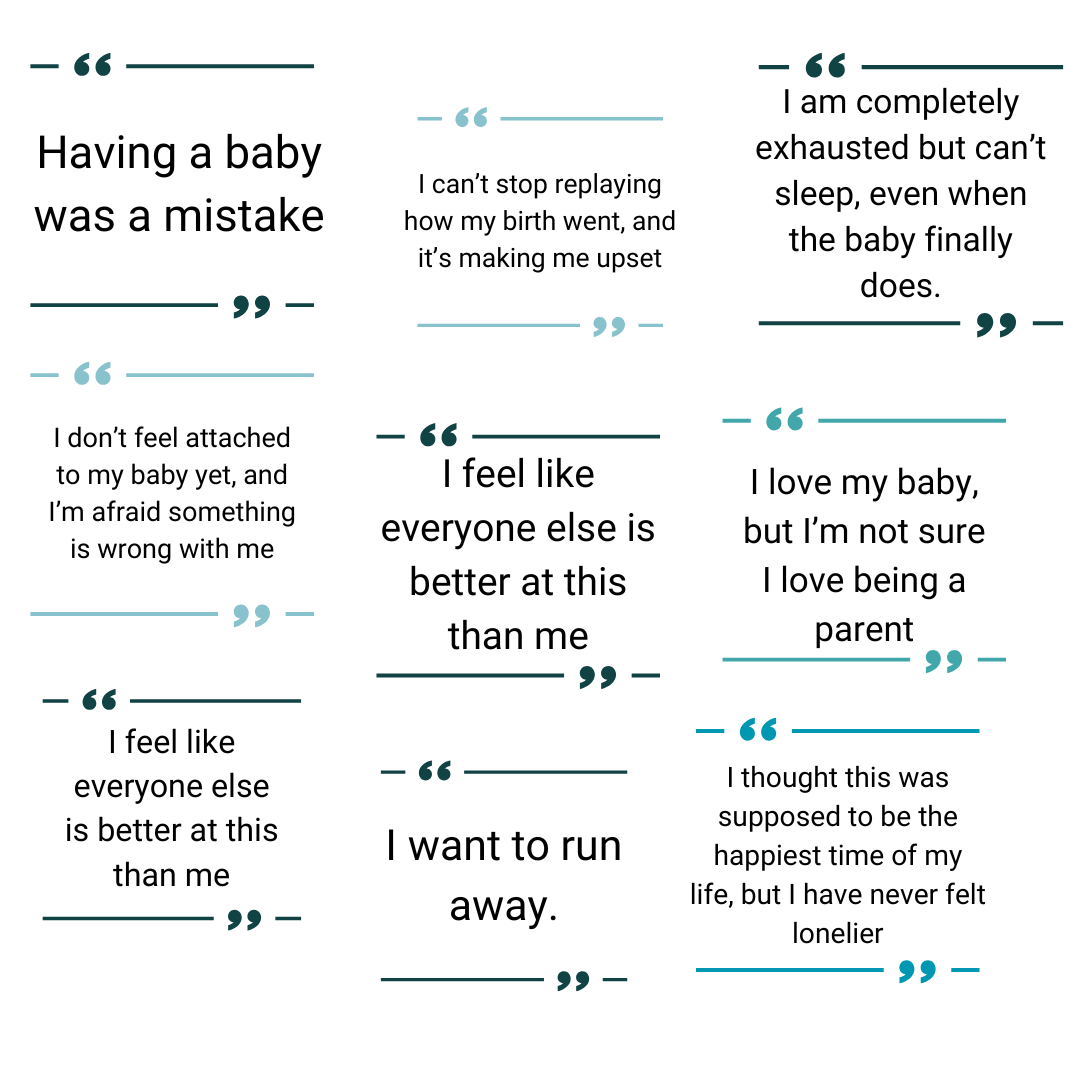
If any of these resonate with you, it is okay to feel this way, and you may benefit from our support.
We can help you by providing mental health support from people who specialize in the reproductive period.
Our paraprofessionals have:
- Specialization in Perinatal Mental Health: Certification in 1 or more areas of perinatal support work (e.g., doula, coach, ICBLC, navigator)
- Extensive Experience: Years of hands-on experience in perinatal care, peer support, patient navigation, and/or coaching
- Empathy and Expertise: A deep commitment to supporting parents with active and compassionate listening & tailored approaches
- Cultural Competency: Mandatory ongoing training to provide sensitive, inclusive support tailored to diverse backgrounds
- Trauma-Informed Lens: Training and expertise in creating a safe space that recognizes and responds to the impact of trauma
- HIPAA-Compliant Practices: All of our paraprofessionals are trained in privacy & confidentiality to protect your personal information
Interested in learning more about the statistics behind the perinatal mental health challenge in the U.S. and the evidence basis for our offering?
The Problem: A Crisis in Perinatal Mental Health Care The perinatal period – spanning pregnancy through one year postpartum – is a pivotal time for mental health, yet it remains alarmingly underserved. While mental health conditions are the most common complication of pregnancy & childbirth, a staggering 75% of birthing people go untreated (MMHLA, 2023). Key statistics and barriers include:
An estimated 1 in 5 birthing people and 1 in 10 supporting partners experience perinatal mental health conditions. Rates are even higher in marginalized populations.
1 in 5 mothers are impacted by mental health conditions, accounting for 800K families in the U.S. each year. Up to 1 in 10 fathers experience postpartum depression, with maternal depression the #1 predictor of paternal depression.
In the US, the population at highest risk for postpartum depression are racial minorities including Black and Hispanic women, with Black women half as likely to receive mental health treatment and counseling as white women.
Source: Maternal Mental Health Leadership Alliance, 2023 Maternal Mental Health Overview Fact Sheet, Hansotte et al., 2017, American Progress, 2024, Eliminating Racial Disparities in Maternal and Infant Mortality
Only 25% of individuals with maternal mental health conditions receive evidence-based treatment, despite its well-documented efficacy.
Due to the lack of screening, ongoing support post-birth for parents, and stigma, perinatal mood and anxiety disorders remain under diagnosed and thus under-treated.
Source: Maternal Mental Health Leadership Alliance, 2023 Maternal Mental Health Overview Fact Sheet
There is a shortage of mental health professionals in the U.S., particularly when it comes to those trained in reproductive mental health.
96% of birthing-aged, American women (62 million) live in maternal mental health professional shortage ages, with 70% of U.S. counties lacking maternal mental health resources, according to the Policy Center for Maternal Mental Health.
13,885 providers are needed across the country to fill the shortage gaps.
Patients must wait weeks to months for mental health appointments, delaying critical support and leading to worsened conditions, particularly for perinatal populations.
As of 2023, the national average wait time for behavioral health services was 48 days (~7 weeks), with longer wait times expected for specialized reproductive mental health services.
This time lag is particularly alarming for perinatal populations, as the first year of life is critical for infant brain development, attachment formation, and bonding with parents. Compounding the challenge is the high risk of perinatal mental health symptom escalation at 2-6 weeks postpartum given coinciding hormonal shifts, sleep deprivation, and increasing psychosocial stressors.
Source: Health Resources and Services Administration (HRSA), 2023 Behavioral Health Workforce Brief
Even after getting an appointment, mental health session costs can be prohibitively expensive, with many unable to afford sustained support.
In most areas of the U.S., a person can expect to pay $100-$200 for generalized therapy sessions. Estimates are even higher if seeking support from a reproductive-specialized therapist.
The Good News: Perinatal Mental Health Support from Doulas & Other Paraprofessionals WORKS. A significant and growing body of evidence validates that paraprofessional support (e.g., support from doulas, coaches, navigators, etc.) leads to significantly improved perinatal mental health outcomes and can bolster the mental health system’s shortage of providers to helping patients get access to support.
Virtual doula support improves patient-reported birth experiences and perceived ability to manage mental health on par with in-person support.
A peer-reviewed study conducted by Maven Clinic found that when certified doulas offered birthing people at least two virtual sessions on topics like developing a birth plan, providing childbirth education, and sharing resources & emotional support, patients reported better birth experiences and perceived ability to manage their mental health (alongside physical benefits, including a 20% reduction in odds of having cesarian births).
In the study, there was a dose-response relationship between doula utilization and birth experience outcomes including “helped me decide my birth preference,” “received high level of support during pregnancy,” “helped me learning medically accurate information,” and “helped me manage my anxiety or depression.” In other words, more doula support sessions led to better perceptual, mental health, AND physical health outcomes for patients.
Sources: Karwa et al., 2024, Fierce Healthcare, 2024
Cognitive Behavioral Therapy (CBT) techniques integral to the doula & coaching models have substantial evidence for perinatal populations, with case studies showing paraprofessionals are equally effective in delivering CBT as licensed professionals when it comes to reducing perinatal depression.
CBT is a gold standard treatment approach for perinatal populations, with strong evidence of its effectiveness in treating perinatal depression and anxiety and preventing symptoms in the perinatal period.
Further, data from the Mothers and Babies program deploying a CBT-based intervention by paraprofessionals and licensed providers demonstrated significantly reduced depressive symptoms with no significant difference in competency across paraprofessionals versus providers.
Sources: UNC SOM, Perinatal Behavioral Health Program Accessed from UNC Psychiatry, Li et al., 2022, Waqas et al., 2023, Moore et al., 2020
Doulas and other paraprofessionals can deliver the consistent emotional support proven to lower risk of postpartum depression.
Consistent emotional support from doulas and other trained paraprofessionals has been shown to reduce the risk of postpartum depression. Research indicates that individuals who receive continuous, nonjudgmental support during pregnancy, labor, and the postpartum period experience significantly lower rates of postpartum depression, improved maternal-infant bonding, and greater satisfaction with their overall perinatal experience.
A landmark Cochrane Review found that continuous support during childbirth was associated with a 31% decrease in the risk of being dissatisfied with the birth experience and a 25% decrease in the risk of postpartum depression symptoms. Additional research in Maternal and Child Health Journal shows that postpartum doula support is associated with significantly fewer depressive symptoms and higher breastfeeding rates.
This kind of care—consistent, emotionally attuned, and grounded in trust—fills a critical gap.
Source: Bohren et. al 2017, Gruber et. al 2013
Doula-client relationships tend to be positive, with support offerings extending well beyond typical provider roles, especially important for the combined challenges of the perinatal period (e.g., emotional changes, education & planning needs, healthcare system navigation challenges).
A qualitative analysis published in Frontiers in Psychiatry found that doula-client relationships tended to be positive more often than not, with doulas supporting patients often in a more holistic fashion versus siloed providers. The study identified several mental-health supporting roles of the doula including instrumental support (i.e., helping clients get their appointments, navigating the health system), emotional support (i.e., being a ‘sounding board’ on common topics impacting mental health like lactation and physical recovery given their unique knowledge), and advocacy support (i.e., tailored/condition-specific support, explaining stress management & coping tactics, facilitating referrals).
Source: Quiray et al., 2024